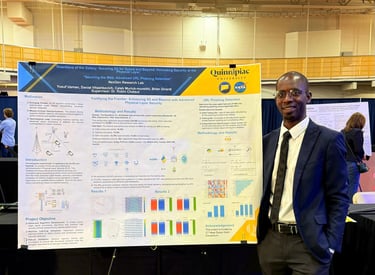
Research Projects
Showcasing AI-driven cybersecurity research.
Data Breach Analysis in the Northeast
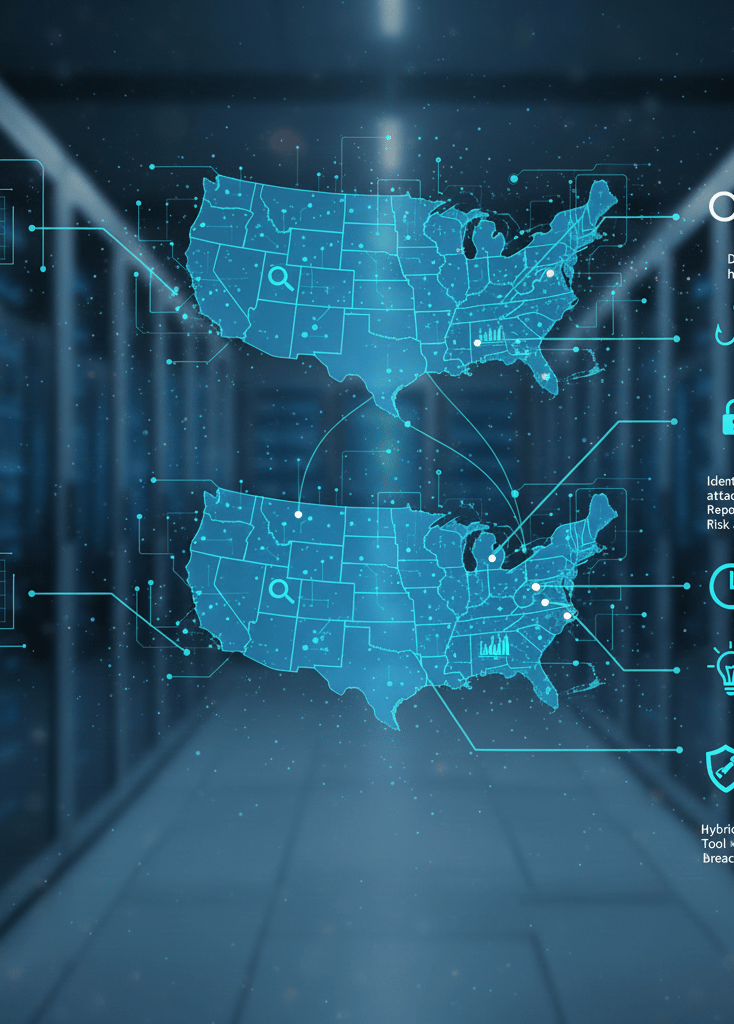
Our research team is conducting in-depth data breach analyses across Connecticut, New York, and Massachusetts to better understand cybersecurity threats and their impact. Ongoing projects include
Analyzing breach trends affecting small businesses, healthcare, and financial sectors across state-reported data.
Identifying the most common attack vectors, including phishing and ransomware, and their consequences on personal data security.
Comparing detection and reporting timelines across states to assess risk management effectiveness.
Developing strategic recommendations tailored to help smaller enterprises improve cyber resilience in a highly connected digital environment.
Building a hybrid “Framework + Software Tool + Pilot Deployment” to support small businesses in identifying vulnerabilities, improving breach response times, and adopting scalable cybersecurity best practices.
AI and ML for Cybersecurity Offense and Defense
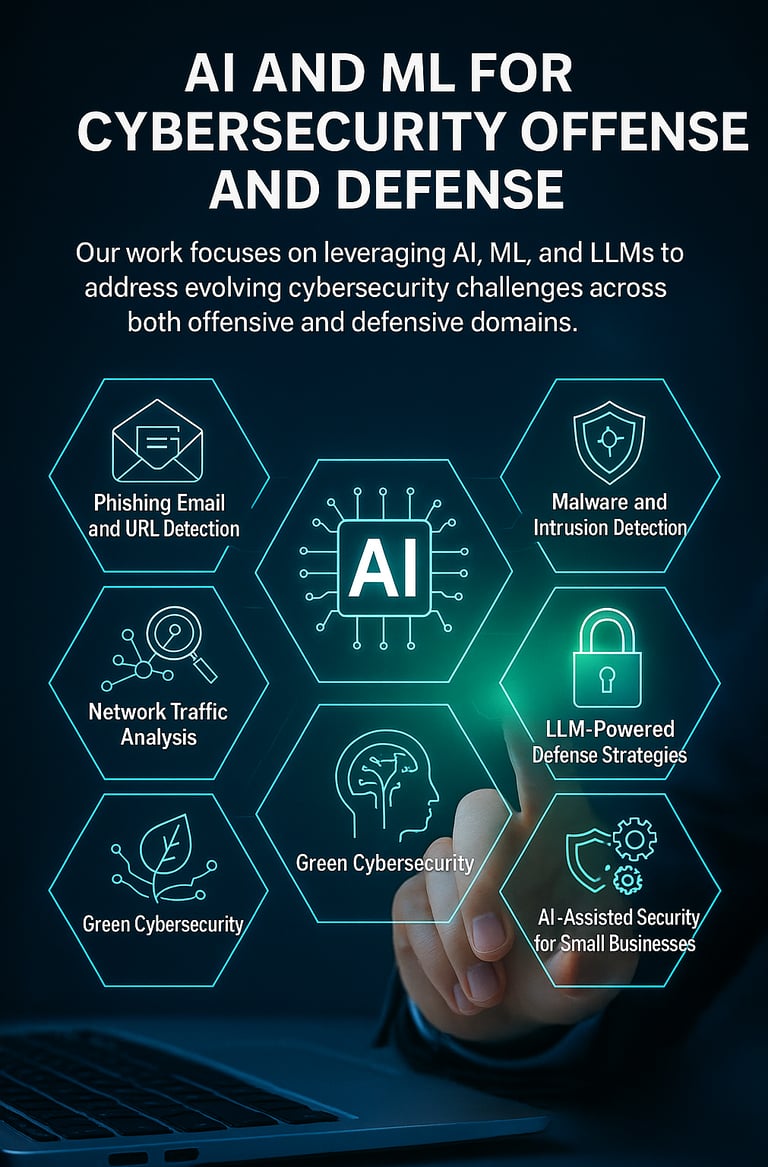
Our research explores the use of AI, ML, and large language models (LLMs) to tackle emerging cybersecurity threats across both offensive and defensive fronts. Ongoing initiatives include
Evaluating ML and LLM-based models for detecting phishing emails, malicious URLs, and deceptive content.
Creating AI-powered tools for malware detection, intrusion monitoring, and secure access control.
Leveraging AI and ML to analyze real-time network traffic for early anomaly and threat detection.
Advancing Green Cybersecurity by optimizing energy-efficient models for sustainable and intelligent threat defense.
Building LLM-driven systems that generate adaptive and resilient defense strategies against adversarial and prompt injection attacks.
Developing accessible, AI-assisted cybersecurity frameworks tailored for small and resource-limited businesses.
Investigating AI and LLM-based solutions for social engineering attack detection, including phishing, smishing, and deepfakes.
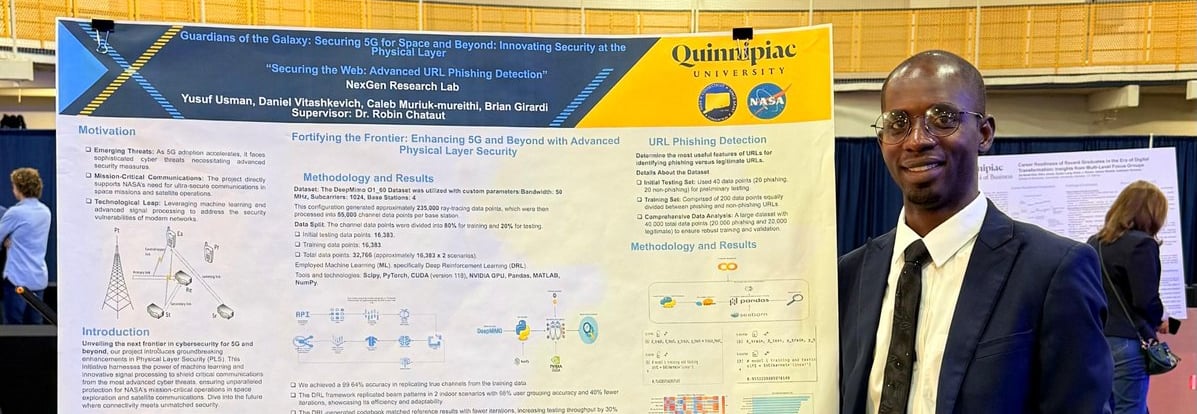
Our research tackles critical challenges across cybersecurity, education, and next-generation networks. We investigate how AI, machine learning, and large language models can strengthen cyber defense, enable autonomous security systems, support small businesses, and improve learning outcomes. We also advance the development of 5G, B5G, and 6G technologies, with a focus on massive MIMO and mmWave systems to achieve faster, more efficient, and more secure communications.

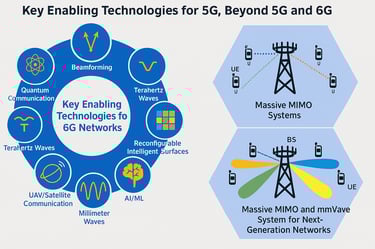
Key Enabling Technologies for B5G and 6G Networks
Our research focuses on advancing the core technologies that will power Beyond 5G (B5G) and 6G networks, addressing critical goals such as ultra-high data rates, low latency, high reliability, energy efficiency, and enhanced security.
Ongoing work includes
Integrating AI, machine learning, and quantum communication to enable intelligent, adaptive, and secure network infrastructures.
Designing efficient algorithms and frameworks for signal detection, channel estimation, channel modeling, user scheduling, and physical layer optimization.
Exploring high-frequency spectrum bands, including millimeter wave and terahertz, alongside ultra-massive MIMO for extreme capacity and performance.
Massive MIMO Systems for Next-Generation Connectivity
A major focus of our research is on the development and deployment of massive MIMO systems a cornerstone technology for B5G and 6G.
Develop low-complexity, high-efficiency algorithms and hardware architectures for real-time signal processing, precoding, and channel estimation.
Address implementation challenges such as pilot contamination, hardware constraints, and user scheduling in dense and dynamic environments.
Apply massive MIMO to Vehicle-to-Vehicle (V2V) and Vehicle-to-Infrastructure (V2I) communication for fast, reliable, and interference-resilient data sharing.
Leverage machine learning and deep learning models to predict channel conditions and enhance physical layer security.
Together, this research aims to build a flexible, intelligent, and secure communication ecosystem for the 6G era and beyond.